Japan - Restless Competitor by Dr Malcolm Trevor Malcolm Trevor
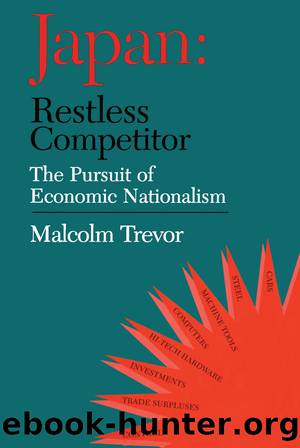
Author:Dr Malcolm Trevor, Malcolm Trevor [Dr Malcolm Trevor, Malcolm Trevor]
Language: eng
Format: epub
Tags: Social Science, Ethnic Studies, General, Regional Studies
ISBN: 9781134278343
Google: yDhdAgAAQBAJ
Publisher: Routledge
Published: 2013-12-16T04:56:27+00:00
Chapter 4
Power Holders â The Iron Triangle
(1) The Bureaucrats: Policy-Makers and Regulators
Will the Japanese ever be democratic? â European businessman.
The Iron Triangle, known also to some as the Devilâs Triangle, is a powerfully evocative image of the grip that the three controlling élites, namely the bureaucracy, big business and political bosses, have on Japan. These âthree biggest sources of powerâ and the collusive relations between them make up a system that differs from that prescribed by the Constitution i.e. âa democratic state, ruled by a popularly elected representative governmentâ. Conspicuous features are âthe dictatorship of the bureaucracyâ and âthe ever-present influence of organized crimeâ, which, coupled with domestic standards of living that do not reflect Japanâs huge economic advances, make these achievements less attractive in the eyes of some Japanese.1
This does not mean that the three groupings always see eye to eye. In other words, they are not a monolith. Business may chafe under bureaucratic regulation, while appreciating that the bureaucracy protects them from intrusion into their cartels, especially by foreigners. Bureaucrats do not like politicians interfering in their decisions and helped to bring about the downfall of one of the most notorious LDP fixers, Shin Kanemaru, ostensibly no more than an ex-vice president of the party at the time but known popularly as âthe Donâ for his skills in behind the scenes manipulation. On the other hand, politicians have been seeking to capitalize on the MOFâs serious loss of popularity due to the financial crisis by getting their hands on the MOFâs power: something that is easier said than done without inside knowledge and leverage.2
At a unifying level, there is general agreement about the direction in which Japanâs politico-economic system should be aimed and how it should be run and it is within this famous âconsensusâ that the three élites exist in a close symbiosis. The membership of the three élites and the vertical order running from those who have worked their way up to the top and control the levers of power down to those who aspire to get power in the future are clearly identifiable:3 as are policies to promote the national economy, such as MITIâs advocacy against Bank of Japan scepticism to protect and nurture the all-important motor industry, or the famous âincome-doublingâ policy of the 1960s. For anyone interested in political theories of how different states are governed, Japan is a textbook example of rule by élites.4
For the bureaucrats the authority to issue or withhpld licences is a major source of power. At the top of the table is the Ministry of Transport; ⦠with complete authority over land, marine and air transport. ⦠and shipping chargesâ, controlling entry to these industries. Despite all the talk about deregulation, it had authority over 2,017 types of licences in 1985, 1,966 in 1991 and still approximately the same number in 1994: not much change in nine years.
In fact, between 1985 and 1991 most ministries had actually increased the number of types of licences under their control. In
Download
This site does not store any files on its server. We only index and link to content provided by other sites. Please contact the content providers to delete copyright contents if any and email us, we'll remove relevant links or contents immediately.
| Anthropology | Archaeology |
| Philosophy | Politics & Government |
| Social Sciences | Sociology |
| Women's Studies |
The Secret History by Donna Tartt(19103)
The Social Justice Warrior Handbook by Lisa De Pasquale(12197)
Thirteen Reasons Why by Jay Asher(8919)
This Is How You Lose Her by Junot Diaz(6894)
Weapons of Math Destruction by Cathy O'Neil(6284)
Zero to One by Peter Thiel(5808)
Beartown by Fredrik Backman(5766)
The Myth of the Strong Leader by Archie Brown(5513)
The Fire Next Time by James Baldwin(5454)
How Democracies Die by Steven Levitsky & Daniel Ziblatt(5225)
Promise Me, Dad by Joe Biden(5157)
Stone's Rules by Roger Stone(5091)
A Higher Loyalty: Truth, Lies, and Leadership by James Comey(4966)
100 Deadly Skills by Clint Emerson(4931)
Rise and Kill First by Ronen Bergman(4797)
Secrecy World by Jake Bernstein(4756)
The David Icke Guide to the Global Conspiracy (and how to end it) by David Icke(4723)
The Farm by Tom Rob Smith(4517)
The Doomsday Machine by Daniel Ellsberg(4493)
